

Cart
0

Table of Contents
- What to Look for in Camping Equipment Before You Buy
- Best Outdoor Gear Materials and How They Affect Longevity
- How to Identify Durable Outdoor Gear by Inspecting Construction
- How to Identify Durable Outdoor Gear Using a Consumer Stress-Test
- Outdoor Gear Warranty Comparison: What Policies Actually Tell You
- Evaluating Second-Hand Gear for Hidden Durability Issues
- Outdoor Gear Maintenance Tips That Extend Gear Lifecycle
- Conclusion
Last Updated: August 4, 2026
Knowing how to identify durable outdoor gear before you buy is the difference between a successful backcountry trip and a gear failure miles from the trailhead. Durability is not a marketing claim you can take at face value, it's a set of physical, material, and construction signals you can read yourself.
Most people evaluate gear by weight, price, and brand name. The right framework starts with material specifications, moves through construction quality, and ends with a hands-on stress test you can run before your first trip.
What to Look for in Camping Equipment Before You Buy
The biggest mistake shoppers make is treating the spec sheet as marketing rather than a technical blueprint. Durable camping equipment communicates quality through specific, measurable values. If a product page lists only vague terms like "heavy-duty" without supporting numbers, that's a red flag.
Step 1: Read the Spec Sheet Like a Builder, Not a Shopper
Start with material weight expressed in denier. Denier measures fiber thickness: higher denier means thicker thread and greater abrasion resistance. A tarp rated at 70D nylon behaves very differently than one rated at 210D. For backpacks and tent bodies, look for denier ratings between 100D and 420D depending on intended use.
Tensile strength measures the maximum load a material can handle before failure. Check the hydrostatic head rating for waterproofing. A hydrostatic head of 1,500mm is the minimum threshold for waterproof fabric under sustained rain. Serious rain gear and tent floors should exceed 3,000mm.
Step 2: Check for Third-Party Certifications and Labels
Third-party certification is one of the most reliable shortcuts for evaluating quality claims. Look for certifications from bluesign, which audits textile production for environmental and performance standards, or the OEKO-TEX Standard 100, which verifies materials are free of harmful substances. According to bluesign Technologies' standards documentation, certified fabrics must meet measurable benchmarks for chemical use, resource efficiency, and worker safety, which correlates strongly with overall material quality.
For waterproofing, ASTM International testing standards govern how waterproof ratings are measured in the US market.
Pro Tip
Third-party certifications indicate a manufacturer who submits materials to external scrutiny, a reliable proxy for overall build quality.
Best Outdoor Gear Materials and How They Affect Longevity
Material choice is where durability is either built in or left out. Outdoor gear longevity depends on the base fabric, its weave structure, and any coatings applied to the surface.
Nylon vs. Polyester: Denier, Ripstop, and Abrasion Resistance Compared
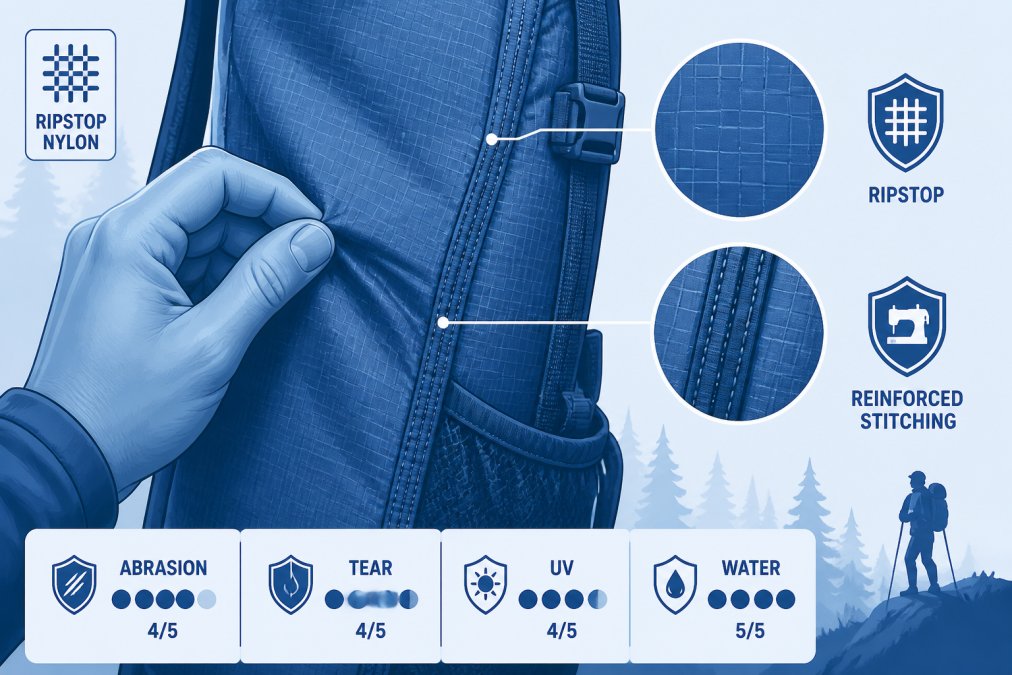
Nylon and polyester are the two dominant fabrics in outdoor gear, and they're not interchangeable. Nylon has superior abrasion resistance and tensile strength, making it the preferred choice for high-wear applications like backpack bodies, tent floors, and stuff sacks. Polyester holds its shape better under UV exposure and resists moisture absorption more effectively, making it a strong choice for tent canopies and rain covers.
Ripstop weave incorporates a reinforcing grid of thicker threads at regular intervals, typically every 5-8mm. When a tear starts, the ripstop grid stops it from propagating. A ripstop nylon rated at 70D can outperform plain-weave fabric at 100D in real-world conditions.
| Material | Abrasion Resistance | UV Resistance | Moisture Absorption | Best Application |
|---|---|---|---|---|
| Nylon (plain weave) | High | Moderate | Moderate | Backpack bodies, tent floors |
| Nylon (ripstop) | High + tear-stop | Moderate | Moderate | Shelters, stuff sacks, jackets |
| Polyester | Moderate | High | Low | Tent canopies, rain covers |
| Recycled Polyester | Moderate | High | Low | Sustainable apparel, pack liners |
| Dyneema Composite | Very High | High | Very Low | Ultralight shelters, dry bags |
DWR Coatings, Seam-Sealed Construction, and Waterproof Ratings
A DWR coating is a durable water repellent finish applied to the outer face of fabric, causing water to bead up and roll off. Without it, even a waterproof membrane underneath will eventually wet out as the outer fabric absorbs moisture.
Seam-sealed construction separates genuinely waterproof gear from water-resistant gear. Taped seams use a heat-bonded strip over every needle hole. Fully seam-sealed means every seam is covered. For serious rain exposure, fully seam-sealed is the only standard that holds up.
Breathability is expressed as a moisture vapor transmission rate, measured in grams of moisture passing through one square meter of fabric in 24 hours. A rating of 10,000g/m²/24h is adequate for moderate activity. High-output activities in wet conditions demand 20,000g/m²/24h or higher.
How to Identify Durable Outdoor Gear by Inspecting Construction
Physical inspection of stitching and hardware is something you can do before you buy, whether handling gear in a store or examining photos online.
Stitching Quality and Stitch Density
Stitch density refers to the number of stitches per inch. Higher stitch density produces a tighter, stronger seam. For load-bearing seams on backpacks and harnesses, look for a minimum of 8-10 stitches per inch. Anything below 6 stitches per inch on a structural seam is a shortcut that will show up as fraying or seam separation under sustained load.
Reinforced stress points are physical indicators of a manufacturer who understands where gear fails. Bar tacks are short, dense rows of stitching applied at attachment points and strap junctions. Box-X stitching, a rectangular stitch with a diagonal cross inside, is the standard for high-load attachment points like shoulder strap anchors. Double-needle stitching on flat seams and folded seam construction on high-wear edges both add longevity.
Hardware Integrity: YKK Zippers, Buckles, and Fasteners
Hardware failure is the most common reason functional gear gets retired. YKK zippers are the industry benchmark for zipper quality. A gear manufacturer who specifies YKK zippers is making a deliberate choice to use proven hardware. Generic zippers with no manufacturer identification are a consistent failure point, particularly in cold or wet conditions.
For buckles and fasteners, look for Duraflex or ITW Nexus hardware. Side-release buckles should snap audibly and hold under lateral pressure without creeping open.
Watch Out
Never assume zipper quality from brand reputation alone. Inspect the zipper slider for manufacturer markings. A premium brand using unbranded zippers on a cost-reduced product line is a known pattern in the outdoor industry.
How to Identify Durable Outdoor Gear Using a Consumer Stress-Test
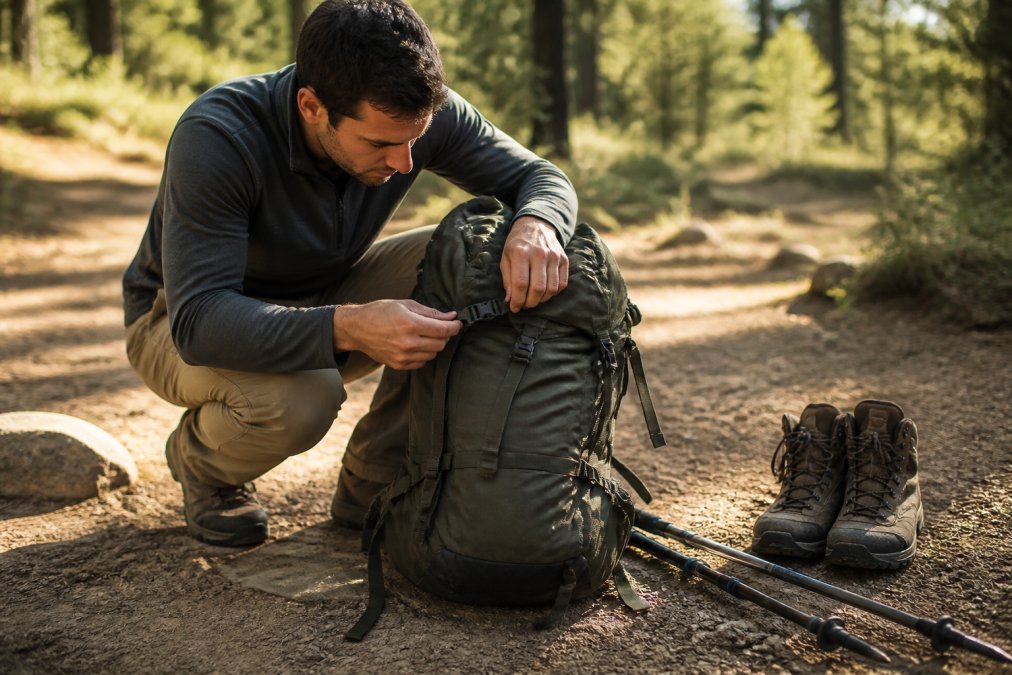
A consumer stress-test is a systematic physical evaluation you run before committing to gear, either in-store or immediately upon receiving an order.
Run through this checklist before your first use:
- Load test straps and attachment points: Fill a backpack to its rated capacity and lift it repeatedly by each strap. Listen for cracking sounds in hardware and watch for stitching distortion at attachment points.
- Cycle every zipper 20 times: Run each zipper the full length of its track under light tension. A quality zipper runs smoothly throughout.
- Pull seams apart with two hands: Apply firm lateral pressure across flat seams. The seam should show no gaping or thread separation.
- Test buckle retention under load: Clip all buckles and apply sustained tension. Release and re-engage each buckle five times. Inconsistent snap engagement or visible flex are failure indicators.
- Check DWR performance: Pour a small amount of water on the outer fabric surface. Water should bead immediately into distinct droplets.
- Inspect articulated joints on apparel: Bend elbows and knees fully while wearing technical apparel. Articulated joints should allow full range of motion without pulling or restricting.
Key Takeaway
The consumer stress-test takes about 10 minutes and catches the majority of construction defects before they become field failures. Make it a habit for every significant gear purchase.
Outdoor Gear Warranty Comparison: What Policies Actually Tell You
A warranty is a manufacturer's statement of confidence in their product. A lifetime warranty on a tent or backpack signals that the company has calculated the failure rate and determined it's low enough to make the guarantee economically sustainable.
Read warranty terms carefully. Many outdoor gear warranties cover manufacturing defects but explicitly exclude normal wear and tear. Look for warranties that specifically cover hardware failure, seam integrity, and coating performance.
The Repair vs. Replace Economic Analysis
Durable outdoor gear has a lower cost-per-wear over its lifecycle than cheaper gear replaced more frequently. A well-constructed backpack lasting 15 years at a higher upfront price almost always costs less per use than a budget version replaced every three to four years.
The calculation changes when repair costs approach the replacement cost of the item. For most gear categories, the tipping point is roughly 40-50% of replacement cost. Below that threshold, repair is almost always the better economic and environmental choice.
Many outdoor gear manufacturers offer direct repair services or maintain networks of authorized repair shops. Repairability should be a purchase criterion: gear with modular components, replaceable zippers, and available spare parts has a fundamentally longer potential service life.
Evaluating Second-Hand Gear for Hidden Durability Issues
Second-hand gear evaluation is a skill that pays off significantly for budget-conscious outdoor enthusiasts.
Start with the fabric surface under direct light. Look for thin spots where the weave has been abraded to near-transparency, or patches of discoloration indicating UV degradation. Check every seam for delamination on taped seams. Press the tape firmly along its length and look for sections that lift or bubble.
Smell the interior of tents and sleeping bags. Mold and mildew penetrate synthetic insulation and down fill permanently, affecting thermal regulation. Test all hardware as you would with new gear. For insulation, lay a sleeping bag flat and observe whether it lofts uniformly. Dead spots that remain compressed after 30 minutes indicate fill that has lost its thermal regulation capacity.
Outdoor Gear Maintenance Tips That Extend Gear Lifecycle
Proper maintenance is where the cost-per-wear calculation gets most favorable. The most important habit is cleaning after every significant trip. Dirt, salt from sweat, and trail grit are abrasive at the microscopic level. Use a technical fabric cleaner rather than standard detergent, which strips DWR coatings and can damage waterproof membranes.
Re-apply DWR treatment when water stops beading on the outer fabric surface. Spray-on and wash-in DWR treatments restore water repellency when applied to clean, dry fabric. Heat activation through a tumble dryer on low heat or a warm iron significantly improves DWR bonding.
Store technical gear loosely, not compressed. Sleeping bags and down jackets stored compressed suffer permanent loft reduction. Lubricate zippers annually with a product designed for the purpose. This single maintenance step prevents the majority of zipper failures on otherwise functional gear.
Choosing gear that holds up across seasons and terrain requires more than reading product descriptions. The construction signals, material specifications, and field-test methods in this guide give you the tools to evaluate quality objectively before you commit. GreatAdventureSupply curates its collections specifically for performance and reliability in real outdoor conditions, offering multifunctional and portable equipment selected to perform when it matters most. Browse the GreatAdventureSupply catalog to find reliable gear that truly enhances your outdoor journeys, making us your trusted partner for all expeditions.
Frequently Asked Questions
What materials make outdoor gear most durable?
High-denier nylon and ripstop weaves consistently outperform standard polyester in abrasion resistance and tensile strength. For waterproofing, look for a DWR coating paired with seam-sealed or taped seams and a hydrostatic head rating above 1,500mm for rain gear. Recycled polyester has improved significantly and now rivals virgin materials in many applications. The spec sheet will list denier count and coating type, which are the two numbers that matter most for predicting how long durable outdoor gear will hold up.
What should I look for in stitching and zippers on outdoor gear?
Stitch density is the first thing to check: tighter, more frequent stitches at reinforced stress points signal quality construction. Bar-tack stitching at strap attachment points and pocket corners is a strong indicator of field-tested durability. For zippers, YKK zippers are the industry benchmark because of their consistent tensile load tolerance and corrosion resistance. Avoid single-stitched seams on load-bearing panels. On waterproof gear, taped seams prevent moisture from wicking through needle holes, which a plain stitch alone cannot stop.
Does price always indicate durability in outdoor gear?
Not reliably. Higher prices often reflect brand positioning or aesthetic design rather than construction quality. The more accurate indicator is cost-per-wear: a moderately priced piece of camping equipment with a solid warranty, repairable zippers, and high-denier fabric will outlast a premium-priced item with proprietary hardware that cannot be serviced. Checking third-party certifications, reading warranty terms, and physically inspecting seam construction will tell you more about durability than the price tag alone.
How do outdoor gear maintenance tips help extend the life of my equipment?
Proper maintenance directly affects gear lifecycle. Refreshing a DWR coating with a low-heat dryer cycle or spray-on treatment restores waterproof performance after washing. Cleaning zippers with a soft brush and applying zipper lubricant prevents corrosion and binding. Storing gear loosely rather than compressed preserves insulation loft and fabric integrity. For tents, UV exposure degrades seam tape over time, so seam-sealing annually adds years of use. These steps reduce the frequency of repair vs. replace decisions and lower your total cost of ownership significantly.
How can I evaluate second-hand outdoor gear for hidden durability issues?
Start by inspecting the highest-stress areas: shoulder strap attachment points, zipper pulls, and any seam that runs along the base of a bag or tent floor. Check for delamination on waterproof fabrics by holding the material up to light and looking for bubbling or separation. Test every zipper and buckle under load before purchasing. On tents, run a hand along taped seams to feel for peeling. A gear item with worn DWR coating is not a dealbreaker since that is field-serviceable, but cracked buckles or fraying at reinforced stress points signal the end of usable life.
What does an outdoor gear warranty comparison actually tell me about durability?
A warranty is a manufacturer's public commitment to their construction quality. Lifetime warranties on hardware like YKK zippers or frame components signal confidence in tensile strength and long-term performance. Look specifically for what the warranty covers: manufacturing defects only, or also material failure under normal use. Warranties that exclude seam failures or DWR degradation shift repair costs to you quickly. A limited one-year warranty on a high-priced item is a red flag. Compare warranty scope, not just length, when evaluating durable outdoor gear options.
This article was written using GrandRanker


