

Cart
0
Table of Contents
- Why Lightweight Fishing Gear Matters for Backpacking
- Best Ultralight Backpacking Fishing Rods
- Compact Reels and Hand Reel Options
- How to Pack Fishing Gear for Backpacking
- Essential Tackle Kits and Minimalist Organization
- Backcountry Fishing Regulations and Permits
- Field Maintenance and Emergency Repairs
- Species-Specific Gear and Sustainable Practices
Last Updated: August 18, 2026
Why Lightweight Fishing Gear Matters for Backpacking
Every ounce counts when hiking into the backcountry, and lightweight fishing gear for backpacking transforms multi-day wilderness trips. Most backpackers skip fishing because traditional rods and reels add too much weight. A complete ultralight fishing system weighs as little as 3-5 ounces, yet delivers genuine catch-and-release capability in alpine lakes and mountain streams.
The real value is opportunity. When your fishing gear weighs almost nothing, you bring it on every trip and fish opportunistically when you spot a promising pool. At GreatAdventureSupply, we've seen countless backpackers discover that a minimalist fishing setup adds protein, recreation, and connection to the landscape without guilt. Traditional spinning combos weigh 12-16 ounces; ultralight systems cut that to 3-8 ounces.
Best Ultralight Backpacking Fishing Rods
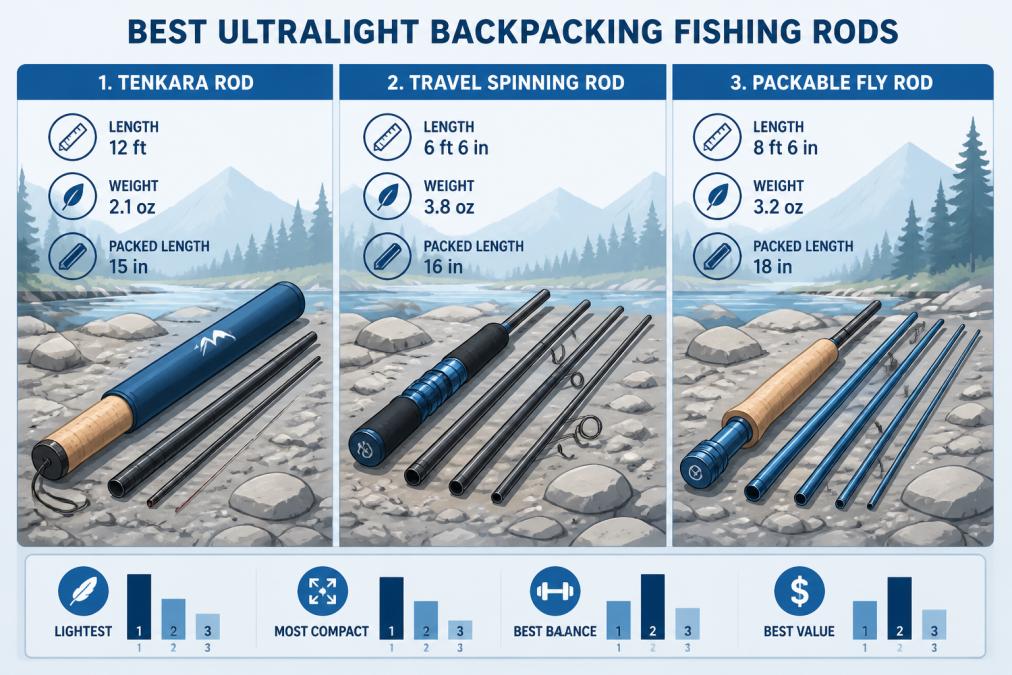
Choosing the right rod is the foundation of any lightweight fishing system. Modern ultralight rods deliver genuine performance in a package that barely registers in your pack.
Tenkara Rod Co. Backpackr Rod
The Tenkara Rod Co. Backpackr Rod represents minimalist fly fishing for backcountry exploration. It collapses to 13.5 inches and weighs just 2.8 ounces, the lightest complete fishing solution available. The triple-zoom design lets you fish at 10'10", 11'10", or 12'10" depending on water conditions. You get a complete kit including rod tube, rod sock, furled tenkara line, hand-tied flies, tippet, and line holder.
Tenkara eliminates the reel entirely. For alpine lakes and small creeks where you're casting short distances and fighting small to medium trout, this becomes irrelevant. You strip line by hand, which teaches better casting mechanics. The tradeoff: limited casting distance and difficulty fighting large fish.
Best for: Anglers committed to fly fishing who prioritize absolute minimum weight.
Pros:
- Exceptional weight savings at 2.8 ounces
- Complete kit arrives ready to fish
- Versatile length adjustments
- Durable construction
Cons:
- Tenkara technique requires practice
- Limited casting distance
- Fewer opportunities in smaller alpine populations
St. Croix Triumph Travel Rod
The St. Croix Triumph Travel Rod breaks into multiple sections and packs into a protective tube without sacrificing performance. The construction uses quality materials throughout, delivering sensitivity and strength instead of the hollow feeling many travel rods provide.
The key advantage is familiarity. If you already know how to fish with a spinning or baitcasting rod, the Triumph feels like home. No learning curve. You arrive at camp, assemble the rod, attach your reel, and fish as you always have. The complete system weighs more than tenkara but delivers the performance and familiarity many anglers prefer.
Best for: Experienced spinning or baitcasting anglers who want traditional performance without bulk.
Pros:
- Genuine St. Croix quality and sensitivity
- Familiar casting mechanics
- Durable construction
- Available in multiple configurations
Cons:
- Heavier than tenkara alternatives
- Requires separate reel purchase
- Multi-piece assembly adds setup time
Daiwa Travel Rod Spinning Combo
The Daiwa Travel Rod Spinning Combo bundles rod and reel together, eliminating compatibility decisions. This combo extends to 7'2" and fishes like a genuine bass rod despite its travel design. The V-joint technology creates a seamless feel when fighting fish.
This is the pragmatist's choice: a complete, matched system requiring minimal setup. Unpack, assemble, fish. The included reel is a quality component, not a budget afterthought. The weight sits between tenkara and traditional setups.
Best for: Backpackers who want a complete, ready-to-fish system without research or assembly.
Pros:
- Complete matched system ready to fish
- Quality reel included
- Full-size performance despite travel design
- Fast assembly
Cons:
- Higher cost
- Heavier than ultralight options
- Less versatile than choosing separately
Compact Reels and Hand Reel Options
Your reel choice matters as much as your rod. The spectrum runs from traditional spinning reels redesigned for weight to hand reels that eliminate mechanical complexity.
The Shimano Vanford FA 500 represents the ultralight spinning reel category at roughly 3.5 ounces, the lightest quality spinning reel available. Paired with an ultralight rod, you're looking at a complete spinning system under 8 ounces.
Hand reels occupy the extreme end of minimalism. The GoReel Hand Reel River Kit weighs 3-5 ounces and delivers absolute simplicity. You wind line manually and retrieve by hand. This works remarkably well for small to medium trout in streams and alpine lakes. You lose casting distance and fighting power but gain weight savings approaching tenkara levels while maintaining a more traditional rod-and-line experience.
Hand reels appeal to ultralight backpackers who fish occasionally and view fishing as a bonus activity. They're also excellent emergency backup systems.
How to Pack Fishing Gear for Backpacking
Packing lightweight fishing gear requires different thinking than traditional equipment. Weight distribution, water protection, and accessibility all change with ultralight systems.
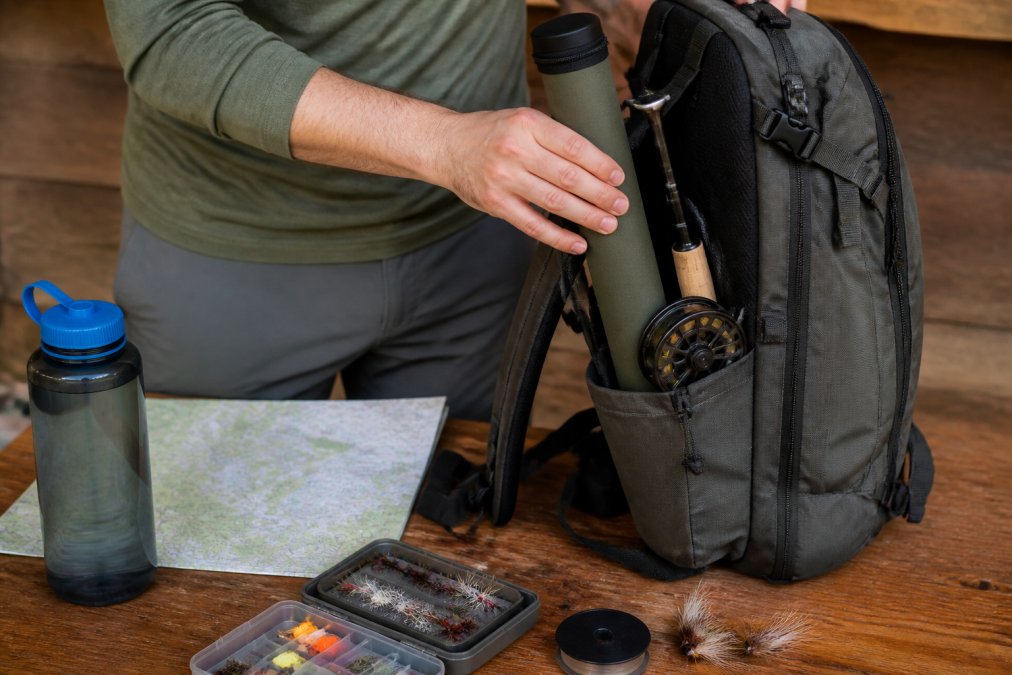
Start with the rod tube. Every ultralight rod system includes one, use it. Place the tube vertically along the outside of your pack, secured with pack straps or elastic cords. This keeps it accessible without taking up internal volume.
Reels and hand reels go in a small mesh bag inside your pack, ideally in a side pocket for quick access. Keep spinning reels in a small waterproof pouch; moisture damages reel longevity in remote areas.
Terminal tackle and flies belong in a compact tackle box or small waterproof container. The CarryCast CarryKit Compact Fishing Tackle Kit measures just 8.2" x 4.2" x 1.6" and fits easily into any pack's side pocket. For minimalists, a small waterproof tin with a dozen flies or lures works equally well.
Line storage matters more than many realize. Coiled line gets tangled. Use the line holder included with tenkara kits, or wrap line around a small spool. Keep it in a waterproof container with your terminal tackle.
Place your fishing system in a pack location that doesn't interfere with primary gear. Most backpackers pack fishing equipment in external pockets or lash it to the pack exterior. Consider weight distribution, balance a rod tube on the outside with other external gear or pack it vertically along your pack's spine.
Essential Tackle Kits and Minimalist Organization
The difference between productive fishing and frustration often comes down to having the right flies or lures. Minimalist tackle organization means carrying enough variety to match conditions without excess weight.
For fly fishing, a dozen flies covering basic patterns, dry flies for surface feeding, nymphs for subsurface hunting, and small streamers for aggressive strikes, covers most situations. For most alpine trout, small flies (sizes 14-18) outperform larger patterns. A small waterproof tin holds everything you need.
For spinning, lures in the 1/8 to 1/4 ounce range work best in small mountain streams and lakes. Include spoons, spinners, and small crankbaits. Five to ten lures in various colors provide enough variety without excess weight.
Terminal tackle essentials include:
- Tippet or leader material (6-8 pound test)
- Hooks (sizes 12-16)
- Split shot or small weights for nymphs
- Swivels and snap swivels
- Needle-nose pliers (under 2 ounces)
Organization prevents frustration. Loose flies or lures get tangled and damaged. A small waterproof container with compartments keeps everything accessible and protected.
Backcountry Fishing Regulations and Permits
Before packing lightweight fishing gear and heading into the wilderness, understand the regulatory landscape. Fishing regulations vary significantly by state, and many backcountry areas have specific rules about species, catch limits, and gear restrictions.
Most states require a fishing license for anyone over a certain age (commonly 16 or 18). Many states offer short-term licenses, 3-day, 7-day, or annual options, at reasonable cost. Purchase your license before your trip; enforcement happens in remote areas, and fines exceed license costs significantly.
Check specific regulations for your destination. National Forests, National Parks, and Wilderness Areas often have different rules than state-managed lands. Some areas prohibit certain species, restrict catch-and-release to specific methods, or mandate catch-and-kill policies for invasive species. A few phone calls to the local ranger district clarifies what's allowed.
According to U.S. Forest Service regulations on backcountry fishing, many wilderness areas prohibit motorized equipment and require catch-and-release only for certain species. Check your specific destination's rules before departing.
Field Maintenance and Emergency Repairs
Lightweight fishing gear still requires basic maintenance in the field. Moisture, sand, and impacts damage equipment, and remote locations offer no repair shops.
Reel maintenance focuses on keeping moisture out. After fishing, dry your reel thoroughly before packing. If fishing multiple days, open the bail and let air circulate each evening. Sand and grit are reel killers; rinse gently with fresh water if needed, then dry completely.
Rod maintenance is simpler. Inspect for cracks or damage after each session. Most ultralight rods are durable, but impacts happen. A small crack often doesn't affect performance immediately but can worsen.
Line maintenance prevents frustration. Inspect for fraying, knots, or weak spots. If you notice damage, cut off the damaged section and re-tie your connection. Carry extra tippet or leader material.
Emergency repairs require minimal supplies. Pack a small sewing kit with thread and needle, and a small tube of super glue. A few feet of electrical tape or duct tape wrapped around a pencil weighs almost nothing and handles dozens of emergencies.
The best emergency prevention is quality gear and careful handling. Treat ultralight equipment accordingly, pack thoughtfully, and inspect regularly.
Species-Specific Gear and Sustainable Practices
Different fish species require different approaches, and backcountry sustainability matters. Understanding what lives in your destination water and how to fish responsibly ensures the resource remains healthy.
Alpine lakes typically contain small to medium trout, brook trout, cutthroat trout, or rainbow trout depending on region and elevation. These fish evolved in cold, clear water with limited food sources, making them opportunistic feeders. Small flies and lures work better than large presentations. Ultralight gear is ideal for alpine trout because the fish are smaller and clear water rewards subtle presentations.
Mountain streams hold similar species in different densities. Small creeks support fewer fish, so catch limits matter more. Check regulations for your specific stream; some areas mandate catch-and-release only, while others allow limited harvest.
Sustainable practices start with catch-and-release done correctly. Keep fish in water as much as possible. Wet your hands before handling to protect their protective slime coating. Remove hooks carefully using needle-nose pliers. If a fish is deeply hooked, cut the line rather than tearing the hook out; fish can often expel hooks naturally.
If harvesting fish for consumption, practice dispatch humanely and efficiently. Keep only what you'll eat.
According to Leave No Trace principles for fishing, minimizing impact on fish populations means respecting catch limits, practicing proper catch-and-release technique, and understanding species-specific regulations.
Consider the ecosystem. Some backcountry lakes have invasive species. In these situations, many agencies encourage anglers to keep all invasive fish to protect native species.
Lightweight Fishing Gear Comparison
| Gear Type | Weight | Best For | Key Advantage | Main Tradeoff |
|---|---|---|---|---|
| Tenkara Rod (Backpackr) | 2.8 oz | Fly fishing minimalists | Lightest complete system | Requires technique learning |
| Travel Spinning Rod (St. Croix) | 6-8 oz | Familiar casting | Quality performance | Heavier than ultralight |
| Spinning Combo (Daiwa) | 8-10 oz | Complete system | Ready to fish | More weight than rod-only |
| Hand Reel (GoReel) | 3-5 oz | Ultralight backup | Extreme simplicity | Limited casting distance |
| Ultralight Reel (Shimano) | 3.5 oz | Spinning perfectionists | Smooth operation | Requires compatible rod |
| Compact Tackle Kit (CarryCast) | 8 oz | Organized fishing | All-in-one convenience | Less customization |
Lightweight fishing gear for backpacking transforms wilderness trips from "maybe I'll bring a rod" to "fishing is part of my adventure." GreatAdventureSupply curates ultralight fishing systems designed for backpackers who refuse to choose between capability and weight. Whether you commit to tenkara minimalism or prefer the familiarity of ultralight spinning setups, the gear exists to make it work. Visit GreatAdventureSupply to explore ultralight rods, reels, and tackle kits specifically selected for backcountry performance and packability, and discover how adding fishing to your trips costs almost nothing in weight but adds immeasurably to your wilderness experience.
Frequently Asked Questions
What is the best lightweight fishing gear for backpacking?
The best lightweight fishing gear balances weight savings with performance. Ultralight backpacking fishing rods like the Tenkara Rod Co. Backpackr (2.8 oz) or travel spinning rods under 8 oz work well. Pair these with compact reels like the Shimano Vanford FA 500 or a minimalist hand reel. Include a small tackle kit (under 1 lb) with essential lures, hooks, and tippet. Choose a collapsible net to save space, and use waterproof storage for terminal tackle. Total weight should add 2-4 lbs to your pack, depending on your fishing style.
How do you pack a fishing rod for backpacking?
Store your rod in a protective rod tube or sock to prevent damage. Place it horizontally along the outside of your pack or vertically in a side compartment. Keep your reel separate in a waterproof pouch to protect it from moisture and sand. Pack tackle in a compact box or tin inside an easy-access pocket. Store tippet, line, and flies in small waterproof containers. Keep your net collapsed and secured with a carabiner. This organization prevents tangling, protects gear, and lets you access fishing equipment quickly without unpacking your entire bag.
What regulations apply to backcountry fishing?
Backcountry fishing regulations vary by state and specific wilderness area. Most states require a valid fishing license, even in remote areas. Check with your state's Department of Fish and Wildlife before your trip for species-specific rules, daily catch limits, and any closures. Many national parks and wilderness areas have their own restrictions on gear type (some prohibit barbed hooks or require catch-and-release only). Some alpine lakes have zero-kill policies or are restricted to fly fishing only. Always verify regulations for your specific destination and obtain required permits in advance.
How much weight should fishing gear add to a backpacking pack?
A complete ultralight fishing setup should add 2-4 lbs to your pack. A tenkara rod with kit weighs around 1.5 lbs, while a travel spinning setup runs 2-3 lbs including reel. A minimalist tackle kit adds 0.5-1 lb, and a collapsible net adds 0.25-0.5 lb. If you're doing a fast-and-light trip prioritizing weight savings, a hand reel system (3-5 oz) plus basic tackle can total under 1 lb. For casual backpackers, adding an extra 3-4 lbs for reliable fishing gear is worth the opportunity to catch fresh meals and enjoy the activity without significantly impacting your overall pack weight.
What is the difference between tenkara and traditional spinning gear for backpacking?
Tenkara rods are ultralight (typically 2-4 oz), require no reel, and excel in small streams and tight spaces. They're faster to set up and ideal for minimalist backpackers. Traditional spinning rods are heavier (6-12 oz with reel) but offer greater casting distance and versatility for larger water. Tenkara suits fly fishing in alpine lakes and creeks; spinning gear works better for diverse species and fishing styles. Tenkara has a steeper learning curve, while spinning is more intuitive for beginners. Choose tenkara for weight savings and technical streams; choose spinning for flexibility and familiar technique.
This article was written using GrandRanker


